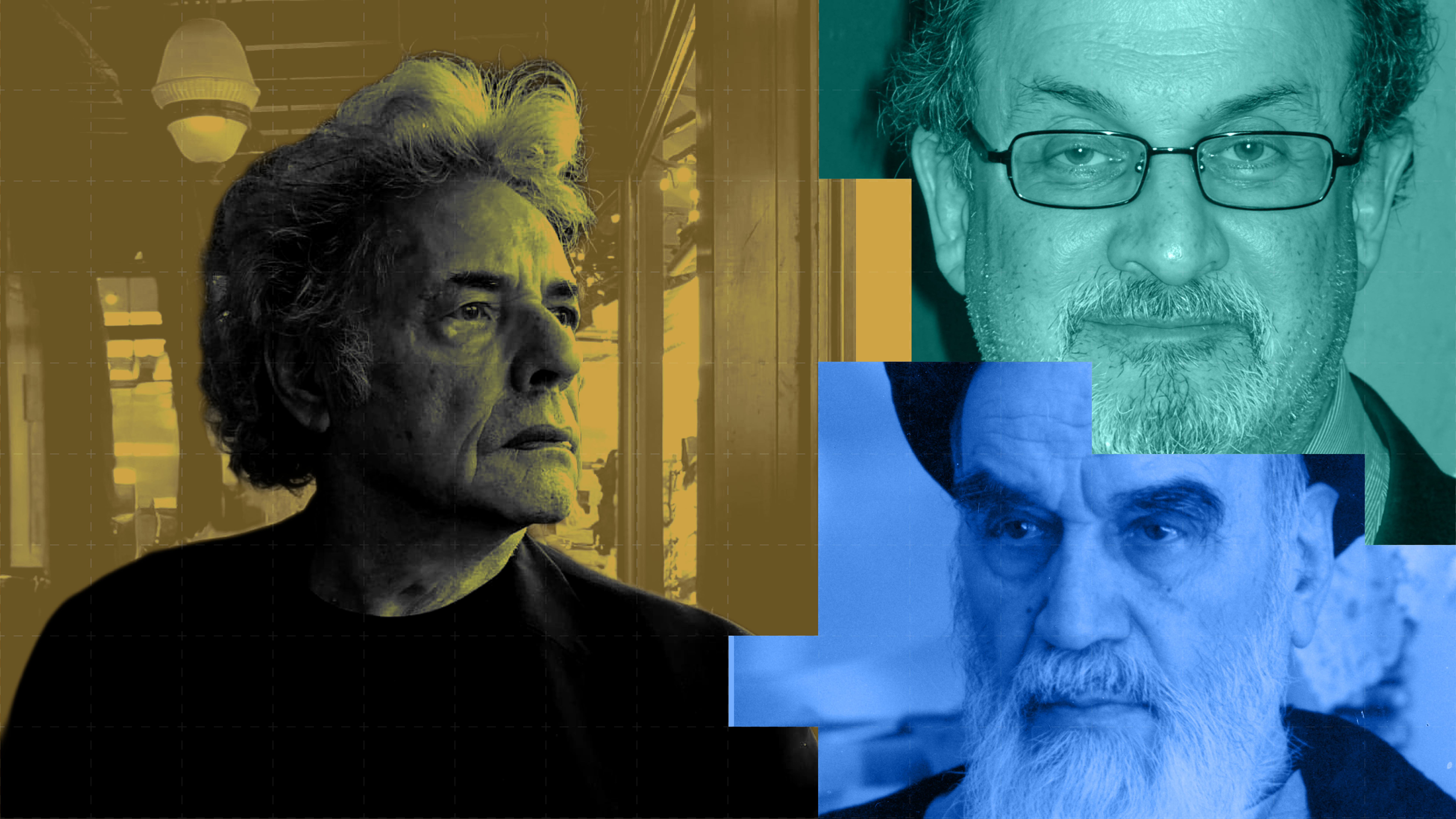
Many thanks to Yves Simon, who agreed to share with LPI his testimony about what he saw and experienced in the aftermath of the murderous fatwa issued by Khomeini against Salman Rushdie. Through concrete facts, this previously unpublished text illustrates the consequences of the politics of terror employed by the Islamic Republic to impose self-censorship on writers and artists living in democratic societies, and silence on the media. The bitter conclusion reached by the French artist and writer sounds a warning alarm.
Do you remember a major event that took place on February 11, 1979?
Two men have never been able to forget it. One was an archaic religious figure who had returned to his homeland, Iran, sporting a thick beard that concealed “the devil’s eyes,” in the words of a Persian friend’s grandmother. His name was Khomeini. The other was an English writer of Indian origin: Salman Rushdie.
The former has just issued a fatwa against the young writer who titled his novel The Satanic Verses. The whole world discovers this unfamiliar word, fatwa—originally, a ruling issued by one or more Islamic authorities, but which, on that day, has become a call to murder a writer. It is a kind of democratic equivalent of calling for the death penalty for someone who has just committed a criminal act. Everyone assumes that, if a crime has been committed, there will be a trial. Yet, for this trial, which would surely be of great importance, no lawyers appear, no judges are present, and no court is convened.
Meanwhile, a fanatic, a sort of former foot soldier of Islam, has just announced to the world, after deliberating with himself, that he is sentencing to death a foreign writer living 3,000 kilometers from his Iranian religious domain. Why “must he die”? My religion, for which I am the advocate, has been offended, wounded once again by that terrifying land of the West: every Muslim, wherever he may be, who has Mr Rushdie within his sphere of existence has an absolute and divine duty to execute him!
French writers angrily sign a petition in support of their English colleague.
That day, at the Olympia—the largest music-hall venue in Paris at the time—a young singer of extraordinary vocal talent and songwriting ability, Véronique Sanson, was performing her recital night after night before packed audiences of 2,300 adoring fans. On stage, Sanson had her beloved piano in front of her, a Steinway. But one enormous problem haunted her repertoire: a song titled, by chance and to her misfortune, Allah.
For the singer, relatively mild threats began to arrive, but very quickly they turned into death threats, issued by Khomeini’s docile sheep then living in France. She stopped singing the ill-fated song Allah and was placed under close protection by the Paris police prefecture.
Bruno Coquatrix, the owner of the Olympia, received a threat of a terrorist attack: “A bomb planted inside the music hall that explodes right in the middle of the grand finale—that would be quite something, wouldn’t it!”
All of this infuriated me! I was impatient to take action. I observed that the bearded Iranian cleric had made headlines around the world with his fatwa against Rushdie, but I imagined that, had he known about Véronique Sanson, there might already have been a fatwa against Sanson, too.
My conclusion was clear: all artists were under threat. There were no longer minor or major artists, as our very own Gainsbourg liked to argue, but simply artists, all of them threatened with death. For a new French petition, I immediately wanted it to have real weight—weight in the number of signatories, but also in their international reach and outstanding moral stature.
I quickly wrote a unifying text that would be entitled: “Against Extremism of Every Kind and in Favour of Tolerance.”
I sent my first draft to close friends—Montand, Signoret, Goldman, and others—in the hope of benefiting from their criticism or securing their support.
Allow me a brief digression here about the most discreet film director in the world, Chris Marker, the cinematic father of the French New Wave—Godard, Truffaut, and the others—but also an inspiration to Francis Ford Coppola, who once spoke to me for a full hour one evening at the Cannes Film Festival about Marker’s work. “It was his first film, La Jetée, that made me want to become a filmmaker.”
When I ran into Chris Marker in Place Dauphine, where he was then living, he told me: “Throughout my entire life, out of a personal moral and ethical conviction, I have never signed a petition. But faced with this cruel monster in a country I love, I will sign.”
Proud of this final, rare signature of his, I counted and recounted the names three times. The signatories were exactly what I had hoped for: one hundred.
The French press responded by publishing the petition free of charge: Le Nouvel Observateur, L’Express, Libération, Le Point, Le Figaro… all except Le Monde, which, I was told, traditionally did not publish petitions without charging a fee.
Thank you, Le Monde! When I paid the substantial bill—which was a significant expense for me—twenty of my friends who had signed the petition volunteered to share the cost. Thank you, my friends.
Very quickly, TF1 and France 2 came to interview me at home about this long list of signatories, which included Françoise Hardy, Jean-Jacques Annaud, Charlotte Rampling, Alechinsky, Wim Wenders, Rosanna Arquette, Peter Gabriel, and others.
What purpose did all this serve?
To make the French public aware of the toxicity of the despot Khomeini, who had hastened to make the wearing of the veil compulsory for young Iranian girls and women, despite having promised the opposite just three years earlier.
It was the beginning of a web of control spreading across Iran’s entire population, tightening year after year, with the Islamic Revolutionary Guard Corps as its accomplice. Today, they brutally suppress every demonstration, including the one in January 2026, which left more than 40,000 people dead in the streets of Iran.
Strangely enough, the French media were often absent when it came to standing by Iran’s bedside, as the country endured the cruel violence of the mullahs, who, for nearly half a century, have turned Iran into a prison with a poisonous atmosphere.