On 22 September 2026, Kaja Kallas, Vice-President of the European Commission, posted a message on X about her meeting, on the sidelines of the United Nations General Assembly, with the Islamic Republic’s foreign minister, Abbas Araghchi: “We discussed diplomatic prospects for ending the war between the United States and Iran and fully reopening the Strait of Hormuz. There were no tolls or transit fees before the war, and there should be none after the war. Navigation must be free and unimpeded, both in the Strait of Hormuz and in the Bab al-Mandab Strait. I also raised domestic repression in Iran, including the sharp rise in executions and death sentences.”
Many Europeans would find nothing objectionable in these remarks, which follow the official line of the European Union and that of many political figures on both the left and the right. Iranian public opinion, however, has taken issue — through countless comments on X — with Kallas’s silence on the massacre of protesters on 8 and 9 January. This gigantic bloodbath took place under a total blackout, imposed to cut Iranians off from the internet for weeks on end and so drastically limit the flow of images and testimonies out of the country. Meanwhile, the regime was spreading — and continues to spread — its deceitful propaganda through its communications apparatus, for instance, the “white SIM card”, which gives unrestricted internet access to people of its choosing in return for loyal service…
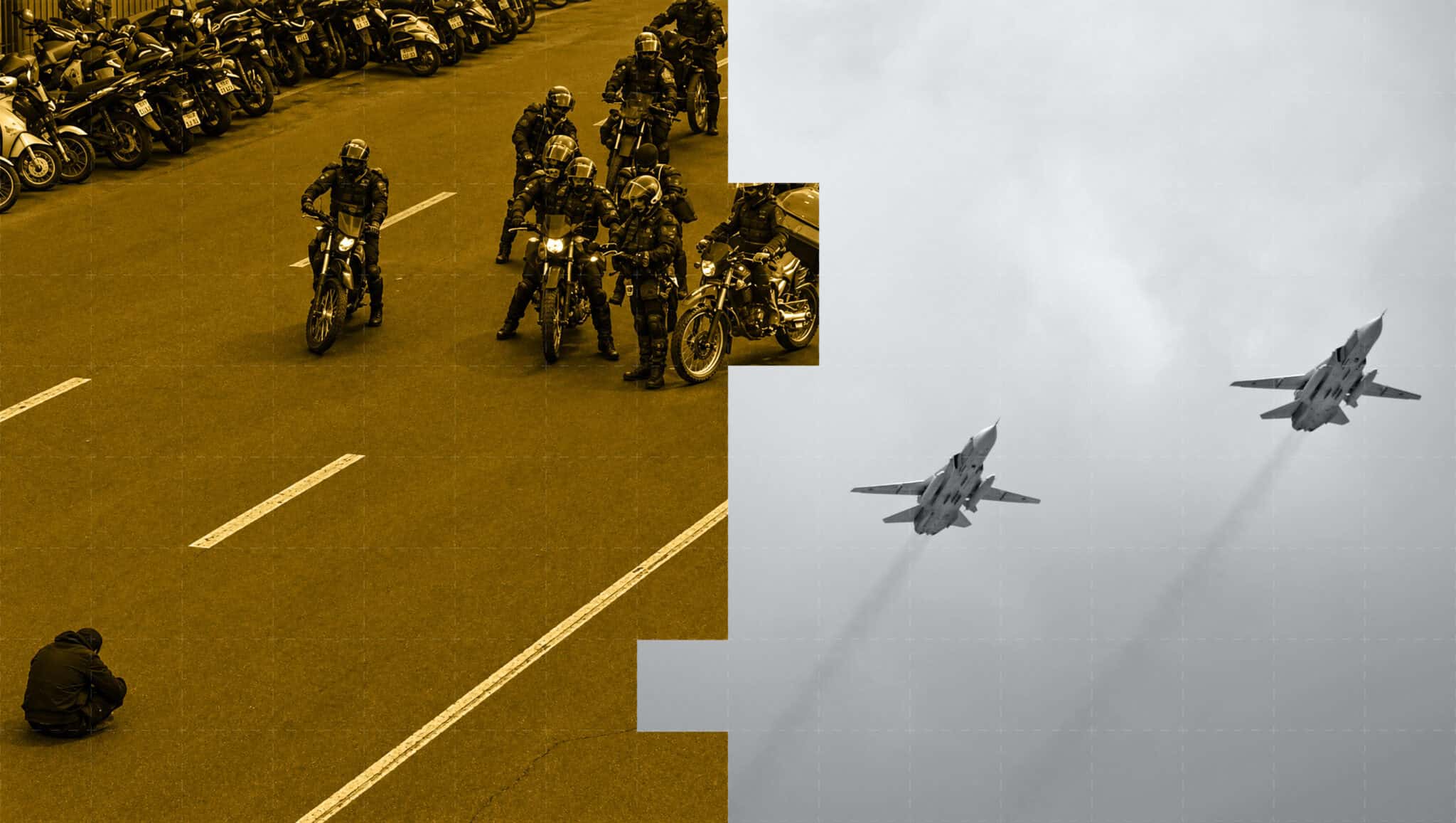
Living every day with the harmful effects of the disinformation deployed by those in power, Iranians have invented ways of naming the words and deeds that play into the regime’s hands. Two expressions are in very common use. The first, maleh-keshi, which in the building trade means “trowelling” or “plastering over”, is used figuratively to mean “whitewashing the regime’s actions”. The second, khoon-shouri, literally “blood-washing”, refers figuratively to any word or deed aimed at concealing the blood shed by the regime. Should we be surprised, then, that socio-political positions on Iran that sidestep the great January massacre are read as complicity with the Islamic Republic — at the expense of a people who did nothing more than take to the streets to voice their demands for change? One example is the montage made from the photo Kallas posted of herself with the Iranian minister: the two of them are shown sitting on a street corner in Iran, where bloodstains on the walls bear witness to the massacre.
Beyond the indignation, a question arises: why is this massacre met with such silence? The question becomes all the more pressing when one observes that a crime of this magnitude is virtually absent from media and political debate in France and other European countries.
How can one fail to notice that the war between the Islamic Republic and the Israeli-American alliance commands almost all media and political attention? And how can one fail to note, too, that perceptions of this conflict, heavily coloured by anti-Trump and anti-Netanyahu sentiment, obscure the war the Islamic Republic is waging against the Iranian people, who are fighting back? The Islamic Republic benefits greatly from this, and makes full use of it in crafting a narrative in which it presents itself as the victim of unjust attacks by malevolent powers bent on crushing it to impose total domination — while casting itself, at the same time, as the resistance.
But what resistance are we talking about here? Quite simply, the famous “axis of resistance” that the Islamic Republic built with Bashar al-Assad (Syria), Hezbollah (Lebanon), the Popular Mobilisation Forces, or Hashd al-Shaabi (Iraq), Hamas, and other armed movements in Palestine. Enormous human and financial resources, drawn from Iran’s wealth, have been devoted to the regime’s ambitions of extending the Islamist ummah and annihilating Israel — objectives that, incidentally, explain the regime’s relentless insistence on the nuclear question. Can we ignore the fact that these ideological ambitions lie at the root of the war now ravaging the country?
The Iranian people have never stopped proclaiming their rejection of this “resistance” agenda, through slogans such as “Neither Gaza nor Lebanon, I give my life for Iran”. This emphasis on attachment to Iran, chanted in a thousand and one ways, is an unequivocal rejection of the Islamist project to turn the people into an ummah governed by sharia — a project that has ended up sanctifying discrimination and violence and making corruption systemic. For some years now, we have been witnessing the gradual rise of a combative Iranian identity, carrying a desire for freedom and equality, and for openness to others and to the world. In 2022, the Woman, Life, Freedom uprising, which erupted after the killing of Mahsa-Jina Amini during an enforcement check on compulsory veiling, brought this deep desire out into the open and signalled the definitive break of entire sections of the population with the regime’s ideology. Then, at the end of 2025, a new and even more broadly popular uprising gave concrete form to this combative Iranian identity through the symbol of the Lion and Sun, associated with the name of Reza Pahlavi, whose programme calls for the end of the Islamic Republic and a transition to democracy.
Faced with immense crowds surging through every region of the country, the regime — having reinforced its forces of repression by calling on its proxies — carried out, on 8 and 9 January 2026, a mass killing that claimed tens of thousands of victims: women, men and children. Thousands of arrests followed. Since then, as the regime’s troops occupy public space, executions of prisoners have proliferated, prolonging the initial massacre. At the same time, to conceal the scale of the crime, the regime has, for the first time, announced a death toll, while shifting responsibility for the massacre onto armed agents acting on the orders of Mossad, the United States or the Kurds, who allegedly organised acts of sabotage and incited violence against the security forces. Masoud Pezeshkian repeated these talking points in his address to the UN Security Council in New York on 24 September 2026.
At a time when the Islamic Republic is mobilising its entire propaganda apparatus — notably its lobbies abroad — to conceal the mass killing and stifle the demands of the Iranian people in revolt, the glaring lack of interest shown by the media and political figures demands serious scrutiny.