
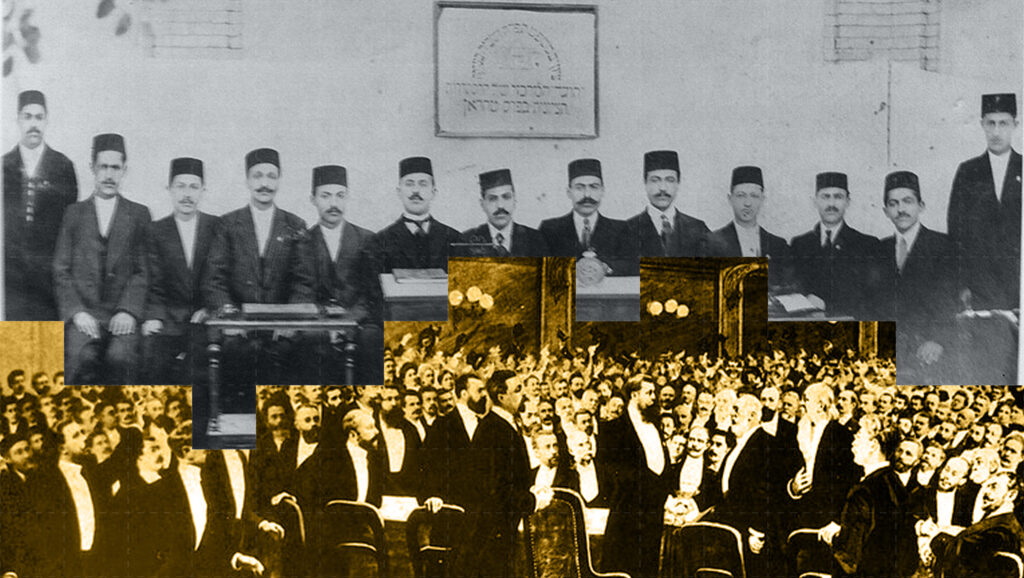
History, Currents, the Kibbutz Movement and the Debate on Colonialism
Few terms are used as often in current debates, and explained as rarely, as “Zionism”. Judaism, the State of Israel, the policies of particular Israeli governments and the Middle East conflict as a whole are repeatedly conflated. The Islamic Republic, which refers to Israel only as the “Zionist regime”, exploits precisely this confusion in its organized disinformation. In the media and on social networks, it turns the term into an enemy image that feeds antisemitic conspiracy narratives and serves the political interests of Islamism. This article responds with historical clarification. It traces the emergence of Zionism, its diverse currents, the kibbutz movement and the debate on colonialism, taking both Jewish and Palestinian experiences seriously. Precise concepts instead of sweeping judgements: this is the precondition for any objective criticism, and also a safeguard against its instrumentalization.
Introduction: Why Zionism Needs Explaining
Zionism is widely discussed today, yet often without a clear account of what the term has historically meant. In public and political debate, Zionism, Judaism, the State of Israel, the policies of particular Israeli governments, occupation and settlement policy, and the Middle East conflict as a whole are repeatedly conflated. As a result, it becomes unclear what is actually being discussed.
These conflations did not first arise after 7 October 2023. Ever since the Zionist movement emerged, political opponents have at times distorted the term through antisemitic notions and conspiracy narratives, in which “the Zionists” appear as a supposedly unified, secret power acting on a global scale. Such interpretations can be found in a range of political and religious milieus, including far-right movements and certain Islamist currents. Despite their opposing ideologies, these milieus can draw on similar antisemitic imagery.
Since Hamas’s terrorist attack on Israel on 7 October 2023 and the ensuing war in Gaza, the disputes have grown sharper still. Terms such as “Zionism”, “anti-Zionism”, “colonialism”, “occupation” and “resistance” are often used without any explanation of their history and meaning. Legitimate criticism of the Israeli government and of the treatment of the Palestinian population at times merges with sweeping condemnations of Israel, of Zionism or of Jewish people.
A clear distinction is therefore needed. Criticism of Zionism or of Israeli policy is not automatically antisemitic. It becomes antisemitic when all Jews are held responsible for Israel’s policies, when classic antisemitic tropes are projected onto Israel, or when “Zionists” are portrayed as a secret world power.
This article therefore asks: What is Zionism, historically? How did the movement come about? Which political, cultural, socialist, and religious currents developed within it? And why is the term understood and judged in such opposing ways to this day?
The text takes a historical approach draws on multiple perspectives. It first explains the concept of Zionism and the conditions that gave rise to it, describes its forerunners and Theodor Herzl’s political Zionism, and then presents the movement’s most important currents. Later chapters cover the revival of Hebrew, the waves of immigration, the building of the Yishuv, the kibbutz movement, and the development of Zionism in Germany and Europe. Finally, the history of Palestine, the founding of the State of Israel, and the debate on colonialism are placed in context.
For many Jews, Zionism became a project of cultural renewal, political security and national self-determination. For many Palestinians, its realization is bound up with the loss of land, flight, expulsion and the absence of self-determination. Both experiences belong to this history. The article therefore treats Zionism not as a unified ideology but as an umbrella term for diverse, sometimes competing movements.
1 Concept and Preconditions
1.1 Zion, Judaism and Modern Nationalism
The name derives from Zion, a biblical name for Jerusalem that later became a symbol of the Land of Israel. The religious longing for Zion endured for centuries. Modern Zionism, however, was something new: a national movement that emerged under the conditions of nineteenth-century Europe. At a time when Italians, Poles, Greeks, and other groups were demanding national self-determination, Jewish thinkers also began to understand Jewry not only as a religion but as a people or nation (Avineri 1981; Penslar 2023).
Judaism and Zionism are therefore not the same. Judaism encompasses religion, cultures, traditions, and a wide variety of communities. Zionism denotes a modern political and cultural movement. Jews could be Zionist, non-Zionist, or anti-Zionist. Non-Jews, too, held Zionist ideas, particularly within parts of Protestant Christianity.
1.2 Before Herzl: Pinsker, Hibbat Zion and the First Aliyah
Theodor Herzl did not invent Zionism. After the pogroms in the Russian Empire from 1881 onwards, groups in the Hibbat Zion (“Love of Zion”) or Hovevei Zion (“Lovers of Zion”) movement emerged. Leon Pinsker’s 1882 pamphlet Auto-Emancipation called for collective Jewish self-help. At the Kattowitz Conference of 1884, representatives of various groups coordinated practical settlement initiatives. Small groups immigrated to Palestine, which was then under Ottoman rule. This First Aliyah, usually dated to the years 1882 to 1903, founded or strengthened agricultural settlements, many of which depended financially on patrons such as Edmond de Rothschild (Laqueur 2003; Shapira 2012).
Aliyah literally means “ascent” and, in Zionist usage, denotes Jewish immigration to the Land of Israel. The term thus already carries a religious and national interpretation.
2 Theodor Herzl and Political Zionism
Theodor Herzl was born in Budapest in 1860 and worked as a journalist in Vienna. He gave the scattered Zionist initiatives an international political form. In The Jewish State (Der Judenstaat, 1896), he argued that social adaptation and legal equality alone could not resolve the Jewish population’s situation. He therefore called for a politically and legally secured home. Herzl thought in the categories of his time: the nation-state, diplomacy, the founding of a chartered company, and international guarantees (Herzl 1896; Avineri 2013).
“We are a people – the enemy makes us one, whether we will it or not.” (Herzl, The Jewish State, 1896)
The sentence reveals Herzl’s starting point. For him, Jewish national belonging arose not only from religion or tradition but also from the shared experience of political exclusion. His answer was a modern political project, not a religious doctrine of redemption.
2.1 The First Zionist Congress in Basel
From 29 to 31 August 1897, Herzl convened the First Zionist Congress in Basel. The congress had originally been planned for Munich but was moved after protests from Jewish community leaders. The delegates founded the Zionist Organization and adopted the Basel Programme.
“Zionism strives to create for the Jewish people a home in Palestine secured by public law.” (Basel Programme, 1897)
The word “home” (Heimstätte) was more cautious than “state”. Herzl wished to avoid an immediate confrontation with the Ottoman Empire and sought an internationally recognized legal basis. A few days later, he wrote in his diary:
“At Basel I founded the Jewish State.” (Herzl, Diary, 3 September 1897)
Herzl held talks with the Ottoman sultan as well as with German, British and Russian politicians. The so-called Uganda Scheme of 1903 – in fact a British offer of territory in East Africa – split the movement. For some Zionists, the priority was the swift creation of a safe refuge; others would accept nothing but Palestine as the destination.
3 Multiple Zionisms
Zionism was never a monolithic political or ideological movement. What united its various currents was the idea that Jews needed some form of national self-determination. What remained contested was the path towards it, the role of religion, culture and socialism, the political order they sought, and the relationship with Palestine’s Arab population.
3.1 Political, Practical and Synthetic Zionism
The political Zionism of Theodor Herzl and Max Nordau relied on diplomacy and international recognition. They sought to secure a Jewish home in law through negotiations with the great powers and the Ottoman Empire. The Zionist Organization and its congresses created the institutional framework for this.
Practical Zionism, by contrast, did not want to wait for an international guarantee. Hovevei Zion and figures such as Menachem Ussishkin promoted immigration, land purchase, and agricultural settlement. A Jewish society was to emerge step by step through concrete work. Later synthetic Zionism combined both approaches: diplomatic recognition alongside building the movement’s own institutions in Palestine.
3.2 Cultural Zionism
Cultural Zionism, associated with Ahad Ha’am, placed cultural renewal, rather than the swift founding of a state, at its centre. Palestine was initially to become a spiritual centre that would strengthen Jewish education, literature and Hebrew culture in the diaspora as well. At the same time, Ahad Ha’am criticized the notion of a largely empty land and warned against unjust treatment of the Arab population.
“It is very difficult to find arable fields in the land that are not under cultivation.” (Ahad Ha’am, Truth from Eretz Israel, 1891, free translation)
Ahad Ha’am was a Zionist and, at the same time, an early critic from within Zionism. His example shows that moral criticism of the methods and consequences of the Zionist project existed within the movement from the very beginning.
3.3 Socialist Zionism and Hebrew Labour
Socialist Zionism combined national self-determination with the building of a society shaped by socialist ideas. Nachman Syrkin, Ber Borochov and A. D. Gordon developed different conceptions. They shared the hope of renewing Jewish society through physical labour, agriculture, and communal ways of life. This current gave rise to workers’ organizations, agricultural collectives and, later, the kibbutz movement. Socialist Zionism shaped the Jewish polity in Palestine and the first decades of Israel.
Within this current, “Jewish” or “Hebrew labour” played an important role. Jewish immigrants were to work the land they had acquired themselves, rather than act merely as owners or employers. The aim was to create an independent Jewish workforce that would provide employment for newcomers and lay the economic foundations of a Jewish society. Hebrew labour was, above all, an instrument of economic self-reliance and Zionist nation-building. Where Zionist enterprises and settlements gave preference to Jewish workers, employment opportunities for Arab workers could diminish. This did not mean that Arab workers were excluded as a matter of principle or everywhere. Practice varied according to period, region, enterprise and political orientation (Shafir 1989; Sternhell 1998).
3.4 Religious Zionism
Religious Zionism linked the national return with the Jewish religion and the theological significance of the Land of Israel. Rabbi Samuel Mohilever supported Jewish settlement in Palestine even before Herzl. Later, Rabbi Abraham Isaac Kook interpreted the building of the land as part of a religious process of redemption. In his view, even secular Zionists could be unknowingly contributing to a divine plan. Religious Zionists thus differed both from the predominantly secular political Zionism and from ultra-Orthodox groups, which rejected a state founded by human agency before the coming of the Messiah.
3.5 Revisionist Zionism
Revisionist Zionism emerged in the 1920s under Vladimir (Ze’ev) Jabotinsky. He criticized the cautious diplomacy and the socialist dominance of the Zionist leadership. Jabotinsky called for a more resolute pursuit of Jewish statehood, strong self-defence and a clear commitment to the goal of a nation-state. Economically, the movement emphasized private property and liberalism. Important organizations and parties of the Israeli right later grew out of it (Shindler 2015).
Jabotinsky assumed that the Arab population would resist the formation of a Jewish majority and a Jewish state. In his 1923 essay “The Iron Wall”, he argued that an agreement would become possible only once the Arab side could no longer prevent the Zionist project. In this, he differed markedly from approaches that relied on an early Jewish–Arab rapprochement.
3.6 Binational Visions
Martin Buber, Judah Magnes and the organization Brit Shalom supported a Jewish home but rejected the permanent rule of one people over the other. They advocated a shared political order with equal rights for Jews and Arabs. This binational approach remained a minority position. However, it shows that support for a Jewish home did not necessarily lead to the demand for an exclusively Jewish nation-state.
The currents overlapped and changed over time. One person could hold practical, religious or socialist views at once. The categories nonetheless help to identify the movement’s internal conflicts and its differing visions of culture, society and statehood.
4 Language, Education and Cultural Renewal
Zionism was also a cultural project. Particularly far-reaching was the revival of Hebrew as a modern everyday language. For centuries, Hebrew had remained primarily a language of religion, scholarship and literature. Eliezer Ben-Yehuda and other language activists coined new words and produced dictionaries and teaching materials. Families, kindergartens, schools, newspapers and institutions of higher education gradually turned Hebrew into a spoken language.
This development was creative but contested. Many Eastern European Jews spoke Yiddish; Sephardi and Mizrahi Jews used Ladino, Arabic and other languages. The primacy of Hebrew initially pushed some of these cultures to the margins. Zionist culture therefore meant renewal and selection at the same time: certain traditions were incorporated into a national culture, while others were devalued or rediscovered only later (Hertzberg 1997; Shapira 2012).
5 The Aliyot and the Building of the Yishuv
Yishuv denotes the Jewish population of Palestine, particularly in the period before 1948. Historians distinguish several waves of immigration, each with its own social and political characteristics:
- First Aliyah (1882–1903): Immigrants, mainly from Eastern Europe and Yemen, founded agricultural settlements, often with private funding.
- Second Aliyah (1904–1914): A smaller but ideologically influential group of socialist pioneers promoted Hebrew labour, collective settlements, and self-defence organizations.
- Third Aliyah (1919–1923): After the First World War and the Russian Revolution, more kibbutzim, trade unions, construction projects, and political institutions emerged.
- Fourth Aliyah (1924–1929): Many immigrants from Poland strengthened urban crafts and small industry, commerce, and the growth of Tel Aviv.
- Fifth Aliyah (1929–1939): Growing persecution in Europe, especially after 1933, brought expertise, capital, science and culture to Palestine.
This periodization is a historical model. People immigrated for a variety of reasons: out of Zionist or religious conviction, because of poverty and persecution, for professional reasons, or because no other refuge was available.
6 The Kibbutz
6.1 Origins and Founding Idea
Kibbutz means “gathering” or “community”. Degania, founded in 1909 or 1910 south of the Sea of Galilee, is generally regarded as the first kibbutz. Ten men and two women from the Second Aliyah organized agriculture, property, and responsibility communally. In the early years, the term kvutza – a small group – was often used; later kibbutzim grew larger.
Communal organization had both practical and ideological reasons. Individual immigrants without means could hardly finance land, tools and irrigation. At the same time, the founders wanted to put socialist ideals into practice. Private property was limited, decisions were made jointly and work was distributed among members. The kibbutz movement thus combined agricultural necessity, social utopia and Zionist nation-building (Near 1992; Gavron 2000).
6.2 Daily Life, Education and Equality
Classic kibbutzim organized production, consumption, kitchen, laundry, education and cultural life communally. Members received no ordinary individual wages; the community provided for their needs. In many kibbutzim, children lived for periods in children’s houses and spent only certain hours with their parents. Supporters saw this as professional collective child-rearing and a relief for women. Critics described emotional strain and a serious intrusion into family life.
Women took part in agricultural and political work from early on. Nevertheless, a gendered division of labour emerged in the kibbutz, too. Women often worked in the kitchen, laundry, care and education, while men took on many leadership positions and the physically demanding work that was more highly valued. The aspiration to full equality was therefore not realized everywhere.
6.3 Significance and Change
Kibbutzim were always a numerical minority, yet they had great influence on agriculture, the labour movement, political leadership, and defence. Some were deliberately founded in strategic border areas. From a Palestinian perspective, therefore, they were not only socialist experiments but also institutions of Jewish settlement and territorial consolidation. Their history encompasses both sides.
After 1948, kibbutzim supported agriculture, the absorption of immigrants, and border security. From the 1980s onwards, many fell into economic crisis. Numerous communities privatized housing, incomes, and services. Today the spectrum ranges from kibbutzim that are still collectively organized to largely privatized residential communities with shared infrastructure.
7 Zionism in Germany and Europe
7.1 Germany
The Zionist Federation of Germany (Zionistische Vereinigung für Deutschland) was founded in 1897. Before 1933, it remained a minority within organized German Jewry. Many German Jews saw themselves as Germans of the Jewish faith and feared that Zionism might call their civic belonging into question. German Zionists, by contrast, criticized complete assimilation and promoted Hebrew, youth work, physical labour and preparation for life in Palestine (Poppel 1977; Brenner 1996).
After the Nazis seized power, what had been an ideological choice increasingly became a matter of escape and survival. Hachshara centres prepared young people for agriculture and crafts; Youth Aliyah brought thousands to Palestine. The Haavara Agreement of 1933 allowed some emigrants to transfer assets to Palestine by exporting German goods. The agreement was fiercely contested among Jewish organizations. It must be understood in the context of the Nazi deprivation of Jewish rights and of forced emigration, not as ideological common ground between National Socialism and Zionism (Nicosia 2008).
7.2 Eastern Europe, Austria, France and Great Britain
In Russia and Poland, Zionism developed more fully into a mass movement, since large Jewish populations lived there. Zionist parties, youth movements and Hebrew schools competed with religious parties, the socialist Bund and other Jewish movements. Vienna became the centre of Herzl’s activity and a hub of German-language Zionist writing and journalism.
In France, the Dreyfus Affair exposed the limits of legal emancipation and social integration. It became an important symbol for Herzl and other Zionists, but it should not be presented as the sole cause of his political thinking.
Through the Balfour Declaration of 1917 and the subsequent Mandate, Great Britain acquired a decisive role. The British government supported a Jewish “national home” while at the same time promising to protect the civil and religious rights of the non-Jewish population. This formula did not resolve the conflict between Jewish and Arab self-determination. British immigration policy changed several times and, in the face of the persecution of European Jews, became an existential question.
8 Palestine, Colonialism and the Arab Population
8.1 Palestine in the Ottoman Empire
In the nineteenth century, Palestine was not an independent nation-state with today’s borders. The territory belonged to the Ottoman Empire and was divided into several administrative districts, some of them governed from Jerusalem, Beirut, and Damascus. “Palestine” nevertheless remained a geographical and historical designation. The absence of a sovereign state does not mean the territory was uninhabited or that its population had no ties to the land.
The population consisted predominantly of Arabic-speaking Muslims. Alongside them, the region was home to Arab Christians, long-established Jewish communities, Druze, Bedouin, Armenians, Circassians and other groups. Jerusalem, Hebron, Safed and Tiberias were important centres of Jewish life. Coexistence among Muslims, Christians and Jews was marked neither by lasting harmony nor by unbroken hostility. There was exchange and neighbourliness, but also social inequality, religious tensions and conflict.
8.2 The Old and the New Yishuv
The long-established Jewish population of Palestine was economically and culturally diverse. Parts of the religious communities lived in difficult conditions and depended on the halukka – donations from Jewish communities in the diaspora. Merchants, artisans, and small entrepreneurs also lived there. Sephardi, Mizrahi, and Ashkenazi Jews spoke Arabic, Ladino and Yiddish, among other languages, and were integrated into regional life to varying degrees.
With the waves of immigration from the 1880s onwards, a “new Yishuv” emerged. Its members came at first mainly from Europe, later from other regions as well. They wanted not merely to live in Palestine but to build a new Jewish society with its own language, education, economy and political organizations.
8.3 British Mandate Rule
Most of today’s Middle Eastern states did not yet exist in their present form in the nineteenth century. After the defeat of the Ottoman Empire in the First World War, Great Britain and France chiefly reordered the former Ottoman territories. Britain received the mandates for Palestine and Iraq, France those for Syria and Lebanon. Transjordan, later Jordan, developed under British influence. Many new borders followed European powers’ interests and cut across existing social and economic ties (Rogan 2009; Krämer 2008).
From 1920 to 1948, Palestine was under British administration. Mandate rule was part of the European imperial order. As early as 1917, the British government had declared its support for “a national home for the Jewish people” in the Balfour Declaration. At the same time, the civil and religious rights of the non-Jewish population were to be protected. The Arab majority, however, was not referred to as a people with political claims of its own.
Britain had held out different, partly contradictory hopes to Arab and Zionist actors. Arab leaders expected independence in return for their support against the Ottoman Empire. At the same time, Britain promoted a Jewish national home. This policy intensified the conflict between the two national movements.
8.4 Immigration, Land Purchase and Nation-Building
From the 1880s onwards, Jews immigrated to Palestine in several waves. Many were fleeing pogroms, legal discrimination, poverty and, later, Nazi persecution. Others came out of religious or Zionist conviction.
Zionist organizations acquired land mainly through purchases from local owners or from large landowners, some of whom lived outside Palestine. The sweeping claim that all the land was simply taken by force before 1948 is therefore historically false. Lawful sales could nonetheless have social consequences. Some plots were lived on or worked by Arab tenants and peasants who did not own them. When ownership changed hands, they could lose rights of use or employment. The extent and circumstances must be examined for each place and period (Shafir 1989; Krämer 2008).
The Yishuv gradually built state-like structures: settlements, schools, the Hebrew University, health services, parties, trade unions, funds, an elected representative body, and self-defence organizations. In parallel, Palestinian Arab nationalism developed. Many Palestinian Arabs feared that immigration would, in the long run, cost them their political majority and control over their homeland. A significant part of the Zionist movement did indeed aim for a Jewish majority and a Jewish state. The result was a conflict between two national movements claiming the same land for self-determination.
8.5 The Holocaust, the Partition Plan and the Founding of the State
The founding of Israel in 1948 can be explained neither without Zionism nor without the Holocaust. Even before the Second World War, the Zionist movement had built up political, economic, social and military institutions. Without these decades of preparation, founding a functioning state so quickly would scarcely have been possible.
At the same time, the Holocaust fundamentally changed the political and moral situation. The Nazi murder of six million European Jews showed that, in the face of mortal danger, Jews had no state of their own that could guarantee them protection and refuge. After 1945, many survivors lived in displaced persons (DP) camps and either would not or could not return to their former home countries. Support for a Jewish state therefore grew, both among survivors and in international politics. However, the Holocaust was neither the beginning of Zionism nor its sole foundation.
At that time, Palestine was not an independent state but a British mandate territory, inhabited by Muslim, Christian and Jewish population groups. Both a Jewish Zionist and a Palestinian Arab national movement had developed there. After the Second World War, Britain was economically and politically weakened and could no longer control the escalating conflict in Palestine. The British government therefore referred the question of Palestine to the United Nations in 1947.
On 29 November 1947, the United Nations General Assembly recommended the partition of the British mandate territory into a Jewish and an Arab state. Jerusalem was to be placed under international administration. Although opinions within the Zionist movement differed on the plan and the proposed borders, the Zionist leadership accepted partition in principle as the basis for founding a Jewish state.
The Palestinian Arab leadership and numerous Arab and Muslim-majority states, by contrast, rejected the partition plan for a variety of political reasons. Among those voting against it were Egypt, Iran, Iraq, Lebanon, Pakistan, Saudi Arabia, Syria, Turkey and Yemen. The Arab side considered it unjust to allot a substantial part of the country to a Jewish state when the Arab population formed the majority at the time. Most opponents of partition called instead for a single state with an Arab majority and a Jewish minority.
Iran, too, voted against the partition plan. The Iranian government instead supported the idea of a single federal state, in which Arab and Jewish areas would be joined under a common central government. Iran thus rejected the proposed partition, but later took no military part in the war against Israel.
On 14 May 1948, Israel declared its independence. The following day, the regular armies of Egypt, Transjordan, Syria, Iraq and Lebanon crossed the borders of the former mandate territory, marking the start of the interstate phase of the war. The Arab states involved sought to prevent the founding of Israel or the implementation of the partition plan, yet they pursued differing and in part competing political and territorial interests. Israel prevailed militarily and, after the war, controlled a larger territory than the UN partition plan had envisaged.
A Palestinian Arab state, by contrast, did not come into being. Transjordan occupied the West Bank, including East Jerusalem, and annexed it in 1950; the country later took the name Jordan. The Gaza Strip came under Egyptian administration without being annexed by Egypt or made into an independent Palestinian state. The territories designated for an Arab state under the UN plan were thus divided among Israel, Jordan and Egypt.
The events of 1947 to 1949 thus mark the transition from British colonial rule to a new order of states. The UN proposed the creation of a Jewish and an Arab state. Despite differing views within the Zionist movement, its leadership accepted the partition plan as the basis for founding Israel. The Palestinian Arab leadership and the Arab states, by contrast, rejected partition and, above all, the establishment of a Jewish state. After the war that followed, Israel was able to secure its existence as a state, while the envisaged Palestinian Arab state did not come into being. Since then, two historical facts have stood side by side: Israel is an existing, internationally recognized state; and the national self-determination of the Palestinians has still not been fully realized.
8.6 The Scholarly Debate on Colonialism
Whether Zionism can be classified as colonialism or settler colonialism is a matter of controversy among scholars. The label is not a neutral description of fact but a historical interpretive model. This model highlights certain features of Zionist settlement, but it can only inadequately explain other parts of Jewish history.
The Jewish relationship to Palestine did not begin with modern Zionism. Jewish communities existed there over many centuries, particularly in Jerusalem, Hebron, Safed and Tiberias. At the same time, large Jewish communities had lived since antiquity in countries of the Middle East and North Africa – in Iraq, Iran, Yemen, Egypt and Morocco, for example. The Jewish people therefore had a religious, cultural and historical connection to Jerusalem and the Land of Israel going back thousands of years, even though for a long time the majority of Jews lived outside that territory.
From the end of the nineteenth century onwards, growing numbers of Jews immigrated to Palestine. Their reasons varied. Many were fleeing pogroms, antisemitic discrimination and political persecution – at first mainly in the Russian Empire and Eastern Europe, later from National Socialism. Others came out of religious conviction or because they supported the Zionist goal of a Jewish national home. After the Holocaust, Palestine – and then Israel – became a possible refuge for many Jewish survivors, because they could not or would not return to their former home countries.
Zionist organizations and Jewish private individuals acquired a large part of their land through legally valid contracts of sale. They often bought the land from private owners, including large Arab landowners. This legal form distinguishes such acquisitions from outright military conquest. Land purchases could nevertheless have social consequences for Arab tenants and peasants if they had to leave the land that had been sold or lost their previous rights of use. The lawfulness of a contract of sale and its social effects must therefore be considered separately.
In support of a colonial classification, some scholars point to the predominantly European origin of many early Zionist immigrants, organized settlement, land purchase, the building of their own institutions and the support, at times, of the British mandatory power. Some Zionist organizations of the time themselves used terms such as “colonization”. Around 1900, however, the word often referred generally to the founding of agricultural settlements and did not, in every context, carry the same meaning as today’s concept of colonialism.
Substantial differences argue against equating Zionism with the classic European colonial empires. The Zionist immigrants did not act on behalf of a mother country seeking to rule Palestine and exploit its raw materials for its own economic benefit. Most of them wanted to live there permanently and build a society of their own. Many were persecuted, deprived of their rights, or stateless. They saw themselves not as agents of a European colonial power but as members of a dispersed people returning to the land of their historical and religious origins in pursuit of national self-determination.
Proponents of the settler-colonial approach, however, do not necessarily regard the absence of a European mother country as counter-evidence. For them, what is decisive is that an immigrant population established permanent settlements and institutions of its own and thereby transformed the social and political conditions of a land that was already inhabited. Critics of this approach object in turn that it gives too little weight to the history of persecution, the statelessness and the historical ties of the Jewish population. Moreover, a sweeping portrayal of all Jewish immigrants as foreign European colonizers can render invisible the long history of the Middle Eastern and North African Jewish communities.
After 1948, large Jewish population groups came to Israel from Iraq, Yemen, Egypt, Libya, Morocco, Iran, and other countries. They were not European colonizers; they came from Middle Eastern and North African societies. Many had experienced discrimination, violence, expropriation or expulsion; others emigrated for religious, political or economic reasons. Israeli society can therefore be described neither historically nor culturally as exclusively a European settler society.
From a Jewish perspective, Zionism can be understood as the national liberation movement of a people long persecuted and frequently stateless. From a Palestinian perspective, the same movement was experienced as a project of immigration and settlement that altered the balance of political power and was ultimately bound up with the loss of homeland, land and self-determination. In the memory of those affected, these two historical perspectives often exclude each other; a scholarly account, however, must examine them together.
Derek Penslar therefore proposes considering the colonial, anti-colonial and postcolonial elements of Zionism side by side, rather than fitting it entirely into a single category (Penslar 2023). The concept of “settler colonialism” can make certain structures of power and settlement visible, but it does not explain the full history of how Zionism came into being. Anyone who uses it should therefore also take into account the Jewish history of persecution, the long connection to the land, the Jewish communities already present there, and the Middle Eastern and North African origins of many Israelis.
8.7 When a Political Interpretation Obscures Violence
An exclusively colonial interpretation can lead to a rigid worldview: on one side stand only “colonizers”, on the other only “the oppressed”. When this schema is applied to Israel and the Palestinians, the distinctions between the Israeli government, the army and the civilian population disappear. Israeli civilians then no longer appear as people with rights of their own and differing political convictions, but collectively as representatives of a supposed colonial project.
It was precisely this reductionism that shaped some reactions to 7 October 2023. Hamas’s Islamist ideology and the deliberate murder, abuse and abduction of people receded into the background. Instead, in some quarters, the attack was described above all as “anti-colonial resistance”. In this way, what was perceived first was no longer what had actually happened, but only the role assigned to those involved within a predetermined political schema.
The term “resistance” can thus bring about a moral reinterpretation: perpetrators become representatives of a liberation movement, and murdered or abducted civilians become supposed representatives of colonial rule. A theory that leaves us unable to recognize concrete people and concrete crimes loses its capacity to shed light. Historical causes must be examined; but they must not serve to render Islamist ideology, antisemitism and inhuman violence invisible or to lend them moral standing.
9 Zionism after 1948
With Israel’s Declaration of Independence, political Zionism achieved its central aim. Thereafter, the meaning of the term changed. Zionism now often denoted support for the State of Israel, the promotion of immigration, and the bond between Israel and Jewish communities worldwide.
The old disputes between the currents persisted. Still contested were the relationship between religion and state, a socialist or market-based economic order, territorial claims, the handling of the territories occupied in 1967, and the question of how Jewish and Palestinian self-determination can be reconciled. Religious-nationalist and revisionist ideas gained influence, while socialist currents lost political strength.
It is analytically problematic to label every Israeli policy as “Zionism”. Specific governments and political forces make decisions on war, occupation, settlement construction, or civil rights. They can and must be criticized in concrete terms. Equally, the historical explanation of Jewish self-determination must not render Palestinian rights and experiences invisible.
Precise Concepts Instead of Sweeping Judgements
Zionism cannot be explained by a single slogan. It arose from Jewish history, European nationalism, religious memory, and modern political organization. It produced a revived everyday language, cultural and political institutions, and social experiments such as the kibbutz. At the same time, it developed in an inhabited land and intensified a conflict over land, political majority, sovereignty, and belonging.
Any historical account that seeks to inform must therefore take two experiences seriously. For many Jews, Zionism meant protection, collective agency and national self-determination. For many Palestinians, its realization meant the loss of land, flight, expulsion and the absence of statehood. Understanding means neither endorsement nor sweeping condemnation. It means keeping concepts, actors, aims and consequences precisely apart.
This precision is also necessary for current debates. Criticism of Israeli policy is legitimate and necessary. It loses its objectivity when it indiscriminately equates Judaism, all Jewish people and Zionism, or when it draws on antisemitic tropes. Conversely, the charge of antisemitism must not be used to push Palestinian experiences and rights out of the debate.
Glossary
| Aliyah | Jewish immigration to the Land of Israel or to Palestine; literally “ascent”. |
| Diaspora | Jewish communities outside the historical Land of Israel. |
| Yishuv | The Jewish population of Palestine, especially before the founding of the state in 1948. |
| Kibbutz | Originally a collectively organized, mostly agricultural community. |
| Hachshara | Vocational and practical preparation for emigration to Palestine. |
| Nakba | Arabic for “catastrophe”; the Palestinian term for the flight and expulsion of 1947 to 1949. |
| Zionism | Umbrella term for diverse movements of Jewish national and cultural self-determination. |
Bibliography and Sources
Ahad Ha’am (1891/2000): Truth from Eretz Israel. Israel Studies 5(2), pp. 160–184.
Avineri, Shlomo (1981): The Making of Modern Zionism. New York: Basic Books.
Avineri, Shlomo (2013): Herzl. Theodor Herzl and the Foundation of the Jewish State. London: Weidenfeld & Nicolson.
Brenner, Michael (1996): The Renaissance of Jewish Culture in Weimar Germany. New Haven: Yale University Press.
Gavron, Daniel (2000): The Kibbutz. Awakening from Utopia. Lanham: Rowman & Littlefield.
Herzl, Theodor (1896): Der Judenstaat. Versuch einer modernen Lösung der Judenfrage. Leipzig and Vienna: M. Breitenstein.
Hertzberg, Arthur (ed.) (1997): The Zionist Idea. A Historical Analysis and Reader. Philadelphia: Jewish Publication Society.
Khalidi, Rashid (2020): The Hundred Years’ War on Palestine. New York: Metropolitan Books.
Krämer, Gudrun (2008): Geschichte Palästinas. Von der osmanischen Eroberung bis zur Gründung des Staates Israel. Munich: C. H. Beck.
Laqueur, Walter (2003): A History of Zionism. From the French Revolution to the Establishment of the State of Israel. New York: Schocken Books.
Near, Henry (1992): The Kibbutz Movement. A History. Vol. 1. Oxford: Oxford University Press.
Nicosia, Francis R. (2008): Zionism and Anti-Semitism in Nazi Germany. Cambridge: Cambridge University Press.
Penslar, Derek J. (2023): Zionism. An Emotional State. New Brunswick: Rutgers University Press.
Poppel, Stephen M. (1977): Zionism in Germany 1897–1933. Philadelphia: Jewish Publication Society.
Rogan, Eugene (2009): The Arabs. A History. London: Allen Lane.
Shafir, Gershon (1989): Land, Labor and the Origins of the Israeli-Palestinian Conflict, 1882–1914. Cambridge: Cambridge University Press.
Shapira, Anita (2012): Israel. A History. Waltham: Brandeis University Press.
Shindler, Colin (2015): The Rise of the Israeli Right. From Odessa to Hebron. Cambridge: Cambridge University Press.
Sternhell, Zeev (1998): The Founding Myths of Israel. Nationalism, Socialism, and the Making of the Jewish State. Princeton: Princeton University Press.
Further Online Resources
– Deutsches Historisches Museum, LeMO: Zionism and Antisemitism in the German Empire.
– Jüdisches Museum Frankfurt: History of the Zionist Federation of Germany.
– United States Holocaust Memorial Museum: Holocaust Survivors and the Establishment of the State of Israel.
– United Nations: History of the Question of Palestine.
– 1914–1918-online. International Encyclopedia of the First World War: Zionism; British Mandate for Palestine.
– International Committee of the Red Cross: Rules of international humanitarian law on the protection of civilians.